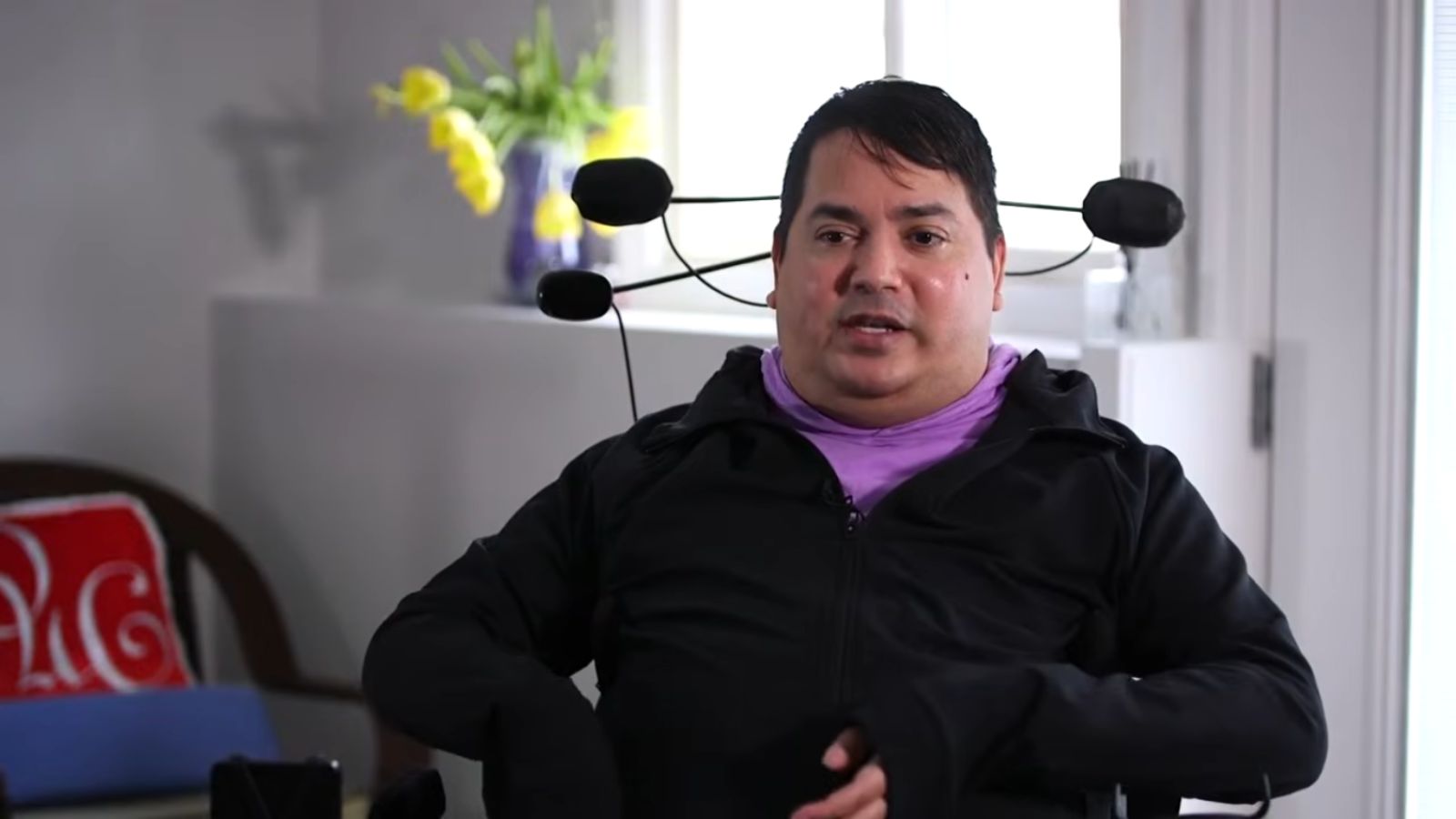
A groundbreaking brain implant has allowed a paralyzed man to regain movement and the sense of touch, letting him feed himself, drink from a cup, and feel his pet dog’s fur for the first time since his injury.
Keith Thomas was paralyzed from the chest down following a swimming pool accident in July 2020. He took part in a three-year clinical trial run by researchers at the Feinstein Institutes for Medical Research, part of Northwell Health in New York.
“I dove in aggressively as usual and then I just blacked out,” Thomas said. “The next day I couldn’t even move.”
Researchers first used functional MRI scans to map the motor and sensory areas of Thomas’s brain, pinpointing exactly where electrodes needed to be implanted.
During surgery, the team stimulated different points directly to confirm the correct placement. “I feel my thumb,” Thomas told them. “My thumb tip. The inside of my thumb tip.” From there, the device was mounted onto his skull, with wires carefully placed across three sensory areas and two motor areas.
The implant, published in Nature Medicine , connects Thomas’s brain directly to a computer, sending motor signals out and stimulation signals back into his body, brain and spinal cord.
According to the study, Thomas’s arm strength increased by 86% on his right side and 62% on his left, with lasting sensation restored in previously numb parts of his wrist even when the implant is switched off.
Outside the lab, that recovery has allowed him to pet his family’s dog and feel her fur on his wrist for the first time since his accident.
“But I like to see an actual person, like a family member, touch you, and feel them, it’s different,” Thomas said.
It is not the first time a brain implant has helped restore independence for someone living with paralysis. A man with ALS went viral after using a Neuralink chip to feed himself with a robotic arm controlled entirely by his thoughts.